
Protein Labeling Reagents

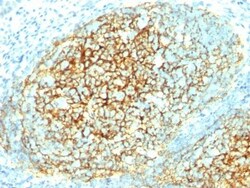
Biotium CD106 / VCAM1(1.4C3), CF568 conjugate, 0.1mg/mL
CD106 (also known as vascular cell adhesion molecule-1, or VCAM-1) is a member of the Ig superfamily of adhesion molecules. It is expressed at high levels on cytokine stimulated vascular endothelial cells, and at minimal levels on un-stimulated endothelial cells. It is also present on follicular and inter-follicular dendritic cells of lymph nodes, myoblasts, and some macrophages. CD106 serves as a ligand for leukocyte beta-1 integrin VLA-4 and mediates cell adhesion of leukocytes to activated endothelium. It plays a role in various immunological and inflammatory responses.Primary antibodies are available purified, or with a selection of fluorescent CF Dyes and other labels. CF Dyes offer exceptional brightness and photostability. Note: Conjugates of blue fluorescent dyes like CF405S and CF405M are not recommended for detecting low abundance targets, because blue dyes have lower fluorescence and can give higher non-specific background than other dye colors.


Biotium CD13(WM15), CF568 conjugate, 0.1mg/mL
Recognizes an integral membrane glycoprotein of 150 kDa, identified as CD13 (also known as aminopeptidase-N). The antibody recognizes an extracellular epitope. The CD13 antigen is present on most cells of myeloid origin including granulocytes, monocytes, mast cells, and GM-progenitor cells. It is also expressed by the majority of AML, CML in myeloid blast crisis, and in a smaller fraction of lymphoid leukemias. CD13 is absent from normal lymphocytes, platelets and erythrocytes. CD13 is also present on fibroblasts; endothelial cells, epithelial cells from renal proximal tubules and intestinal brush border, bone marrow stromal cells, osteoclasts, and cells lining bile duct canaliculi. CD13 is identical to aminopeptidase N (APN), a prominent membrane-bound metalloprotease present on the surface of intestinal brush border and renal tubules. CD13 plays a role in metabolism of biologically active peptides, in phagocytosis, and in bactericidal/tumoricidal activities. It also serves
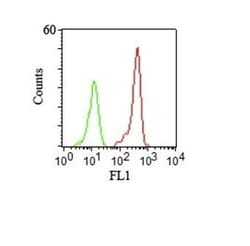
Biotium CD46(122.2), CF568 conjugate, 0.1mg/mL
CD46 acts as a cofactor for complement factor I, a serine protease, which protects autologous cells against complement-mediated injury by cleaving C3b and C4b deposited on host tissue. It may be involved in the fusion of the spermatozoa with the oocyte during fertilization. CD46 acts as a co-stimulatory factor for T-cells, which induces the differentiation of CD4 into T-regulatory 1 cells. T-regulatory 1 cells suppress immune responses by secreting interleukin-10, and therefore are thought to prevent autoimmunity. A number of viral and bacterial pathogens seem to exploit this property and directly induce an immunosuppressive phenotype in T-cells by binding to CD46.Primary antibodies are available purified, or with a selection of fluorescent CF Dyes and other labels. CF Dyes offer exceptional brightness and photostability. Note: Conjugates of blue fluorescent dyes like CF405S and CF405M are not recommended for detecting low abundance targets, because blue dyes have lower
Biotium CD36(185-1G2), CF568 conjugate, 0.1mg/mL
Recognizes a protein of 80 kDa-90 kDa, identified as CD36 (Workshop IV; Code P-26). Its epitope maps between aa155-183. It is expressed on platelets, monocytes and macrophages, microvascular endothelial cells, erythrocyte precursors, mammary epithelial cells, and some macrophage derived dendritic cells. CD36 acts as a receptor for thrombospondin (TSP), collagen types I, IV and V, P. falciparum malaria-infected erythrocytes, and sickle erythrocytes. It also functions as a scavenger receptor, mediating macrophage uptake of oxidized low-density lipoprotein (LDL) and recognition of apoptotic polymorphonuclear leukocytes (PMN). CD36 plays a role in platelet aggregation, macrophage foam cell development, inflammation, and the tissue ischemia observed in sickle cell disease and cerebral malaria. Note that 1-4% of Japanese and East Asia population lack CD36. This MAb blocks adhesion of P. falciparum parasitized red blood cells to CD36 and strongly inhibits collagen-induced platelet a
Biotium GFAP(GA-5), CF568 conjugate, 0.1mg/mL
This MAb recognizes a protein of ~50 kDa which is identified as Glial Fibrillary Acidic Protein (GFAP). It shows no cross-reaction with other intermediate filament proteins. GFAP is specifically found in astroglia. GFAP is a very popular marker for localizing benign astrocyte and neoplastic cells of glial origin in the central nervous system. Antibody to GFAP is useful in differentiating primary gliomas from metastatic lesions in the brain and for documenting astrocytic differentiation in tumors outside the CNS.Primary antibodies are available purified, or with a selection of fluorescent CF Dyes and other labels. CF Dyes offer exceptional brightness and photostability. Note: Conjugates of blue fluorescent dyes like CF405S and CF405M are not recommended for detecting low abundance targets, because blue dyes have lower fluorescence and can give higher non-specific background than other dye colors.
Biotium CD86(BU63), CF568 conjugate, 0.1mg/mL
Recognizes a protein of 70 kDa, which is identified as CD86. CD86, along with CD80/B71, is an important accessory molecule in T cell co-stimulation via its interaction with CD28 and CD152/CTLA4, a cancer immunotherapy target. It is a type I transmembrane glycoprotein and a member of the immunoglobulin superfamily of cell surface receptors. It is expressed at high levels on resting peripheral monocytes and dendritic cells and at very low density on resting B and T lymphocytes. CD86 expression is rapidly upregulated by B cell specific stimuli with peak expression at 18 to 42 hours after stimulation. Since CD86 has rapid kinetics of induction, it is believed to be the major CD28 ligand expressed early in the immune response. It is also found on malignant Hodgkin and Reed Sternberg (HRS) cells in Hodgkin's disease.Primary antibodies are available purified, or with a selection of fluorescent CF Dyes and other labels. CF Dyes offer exceptional brightness and photostability. N

Biotium CD11b(M1/70), CF568 conjugate, 0.1mg/mL
CD11b is a cell adhesion molecule that acts as a receptor for cell surface ligands such as intracellular adhesion molecules (ICAMs) or soluble ligands. Integrins are heterodimeric proteins that contain an alpha chain and beta chain. IntegrinαM combines with the Integrinβ2 to form a leukocyte-specific integrin referred to as macrophage receptor 1 (Mac-1), or inactivated-C3b (iC3b) receptor 3 (CR3). IntegrinαM/β2 is important in the adherence of neutrophils and monocytes to stimulated endothelium, and also in the phagocytosis of complement coated particles. The protein CD11b has been implicated in the various adhesion-related interactions of cells such as monocytes, macrophages, natural killer (NK) cells, and granulocytes. It is part of a heterodimer that consists of CD11b and CD18. It also modulates the uptake of complement-coated particles within the cell. It is commonly used as a microglial marker in tissues derived from the nervous system.Primary antib
Biotium IGF-1(M23), CF568 conjugate, 0.1mg/mL
This antibody is specific to Insulin-like Growth Factor (IGF-1) and shows minimal cross-reaction with IGF-11, Proinsulin, MSF, and Insulin. IGF-1 is a polypeptide growth factor with two isoforms that are produced by alternative splicing. Isoform 1 is also known as IGF-IB while isoform 2 is known as IGF-IA. IGF-1 stimulates the proliferation of a wide range of cell types including muscle, bone and cartilage tissue. It functions as an autocrine regulator of growth. Activation of IGF system has emerged as a key factor for tumor progression and resistance to apoptosis in many cancers like those of breast, thyroid and colon.Primary antibodies are available purified, or with a selection of fluorescent CF Dyes and other labels. CF Dyes offer exceptional brightness and photostability. Note: Conjugates of blue fluorescent dyes like CF405S and CF405M are not recommended for detecting low abundance targets, because blue dyes have lower fluorescence and can give higher non-specific
Biotium PLGF(PLGF94), CF488A conjugate, 0.1mg/mL
The onset of angiogenesis is believed to be an early event in tumorigenesis and may facilitate tumor progression and metastasis. Several growth factors with angiogenic activity have been described. These include Fibroblast Growth Factor (FGF), Platelet Derived Growth Factor (PDGF), Vascular Endothelial Growth Factor (VEGF) and Placenta Growth Factor (PLGF). Placenta growth factor (PLGF) is a secreted protein primarily produced by placental trophoblasts but also expressed in other endothelial cells and tumors. There are three isoforms, PLGF-1, PLGF-2, and PLGF-3. PLGF-2 is expressed up until week 8 in the placenta; the placental tissues continuously express PLGF-1 and PLGF-3 but only PLGF-1 is found in colon and mammary carcinomas. PLGF acts to stimulate angiogenesis, endothelial growth and migration. PLGF is a powerful promoter of tumor growth and is upregulated in some cancers, and PLGF is thought to aid in atherosclerotic lesions and neovascular growth surrounding the lesio
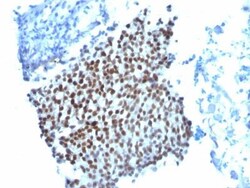
Biotium p21 / WAF1(WA-1), CF568 conjugate, 0.1mg/mL
This MAb recognizes a 21 kDa protein, identified as the p21WAF1 tumor suppressor protein. This MAb is highly specific to p21 and shows no cross-reaction with other closely related mitotic inhibitors. p21WAF1 is a specific inhibitor of cdk s and a tumor suppressor involved in the pathogenesis of a variety of malignancies. The expression of this gene acts as an inhibitor of the cell cycle during G1 phase and is tightly controlled by the tumor suppressor protein p53. Its expression is induced by the wild type, but not mutant, p53 suppressor protein. Normal cells generally display a rather intense nuclear p21 expression. Loss of p21 expression has been reported in many carcinomas (gastric carcinoma, non-small cell lung carcinoma, thyroid carcinoma). In ELISA, MAb WA-1 is useful either as a solid phase or for detection of p21 protein.Primary antibodies are available purified, or with a selection of fluorescent CF Dyes and other labels. CF Dyes offer exceptional brightness and ph
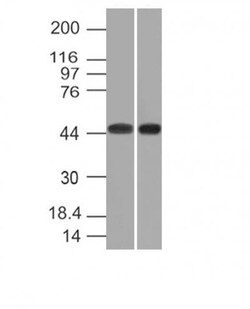
Biotium CD33(C33/69), CF568 conjugate, 0.1mg/mL
Recognizes a 67 kDa glycoprotein, which is identified as CD33. It is a transmembrane protein of the sialic acid-binding immunoglobulin-like lectin (Siglec) family. It belongs to the immunoreceptor tyrosine-based inhibitory motif (ITIM)-containing molecules able of recruiting protein tyrosine phosphatases SHP-1 and SHP-2 to signal assemblies; these ITIMs are also used for ubiquitin-mediated removal of the receptor from the cell surface. CD33 is expressed on cells of myelomonocytic lineage, binds sialic acid residues in N- and O-glycans on cell surfaces, and is a therapeutic target for acute myeloid leukemia. CD33 is expressed on myeloid progenitors, monocytes, granulocytes, dendritic cells and mast cells. It is absent on platelets, lymphocytes, erythrocytes and hematopoietic stem cells.Primary antibodies are available purified, or with a selection of fluorescent CF Dyes and other labels. CF Dyes offer exceptional brightness and photostability. Note: Conjugates of blue fluor
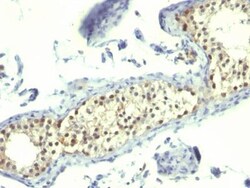
Biotium Complement C4d(C4D205), CF568 conjugate, 0.1mg/mL
This MAb is specific to Complement 4d (C4d) and it reacts with the secreted as well as cell-bound C4d.C4d is a degradation product of the activated complement factor C4b. Complement 4b is typically activated by binding of Abs to specific target molecules. Following activation and degradation of the C4 molecule, thio-ester groups are exposed, which allow transient, covalent binding of the degradation product Complement 4d to endothelial cell surfaces and extracellular matrix components of vascular basement membranes near the sites of C4 activation. The presence of C4d in peritubular capillaries is a key indicator for acute humoral (i.e. antibody-mediated) rejection of kidney, heart, pancreas and lung allografts. As an established marker of antibody-mediated acute renal allograft rejection and its proclivity for endothelium, this component can be detected in peritubular capillaries in chronic renal allograft rejection as well as hyperacute rejection, acute vascular rejection, a
Biotium Cytokeratin 19(KRT19/800), CF640R conjugate, 0.1mg/mL
Recognizes a protein of 40 kDa, identified as cytokeratin-19 (CK19), which is expressed in sweat gland, mammary gland ductal and secretory cells, bile ducts, gastrointestinal tract, bladder urothelium, oral epithelia, esophagus, and ectocervical epithelium. Anti-CK19 reacts with a wide variety of epithelial malignancies including adenocarcinomas of the colon, stomach, pancreas, biliary tract, liver, and breast. Perhaps the most useful application is the identification of thyroid carcinoma of the papillary type, although 50%-60% of follicular carcinomas are also labeled. Anti-CK19 is a useful marker for detection of tumor cells in lymph nodes, peripheral blood, bone marrow and breast cancer.Primary antibodies are available purified, or with a selection of fluorescent CF Dyes and other labels. CF Dyes offer exceptional brightness and photostability. Note: Conjugates of blue fluorescent dyes like CF405S and CF405M are not recommended for detecting low abundance targets, bec